Listen on: Apple Podcasts | Spotify | Amazon Music | Podcast Index | Overcast | YouTube
I just got back from Switzerland, where, of course, I ate plenty of Swiss chocolate. Sitting around one evening with several Swiss physician friends, chocolate in hand, I found myself wondering what many of us quietly want answered: is chocolate actually good for us? I’d love to believe it is. But I know one downside firsthand — if I eat a chocolatey dessert in the evening, I don’t sleep as well. Even a couple of brownies near dinner will cost me that night.
I’ll admit a bias. I have no financial stake here, but I love chocolate, so I badly want it to be good for us. I’ll keep my open-minded-skeptic hat on anyway.
Must be the chocolate
Last year the average Swiss person ate about 22.7 pounds of chocolate; the average American, roughly 8. That’s 15 extra pounds a year — some 37,000 additional calories. And yet the Swiss aren’t heavier than we are, and they enjoy one of the highest life expectancies in the developed world — about 84 years, versus 78 in the United States.
Must be the chocolate, right? Obviously not. Switzerland and the United States differ in wealth, diet, activity, and a thousand other ways. Which is the first lesson: association is easy, causation is hard. Still, it leaves a real question — is there something in chocolate that is genuinely good for us?
We want the answer to be yes. In one industry snacking survey, 65% of people said they’d sooner give up social media than chocolate for a month, and 72% agreed a world without chocolate would be a world without joy. We are not neutral judges here.
We’ve been calling it medicine for centuries
Chocolate didn’t begin as candy. Its roots are Mesoamerican — the Olmec, Maya, and Aztec cultures — where cacao was a bitter ceremonial beverage, a status marker, even a currency. Cortés carried it to Europe in the 1500s and sugar did the rest — but it wasn’t sold only for pleasure. For centuries chocolate was prescribed as medicine — to restore energy, help frail patients gain weight, aid digestion, and treat illness, and we’ve been trying to make it a health food ever since.
Which chocolate, and which part?
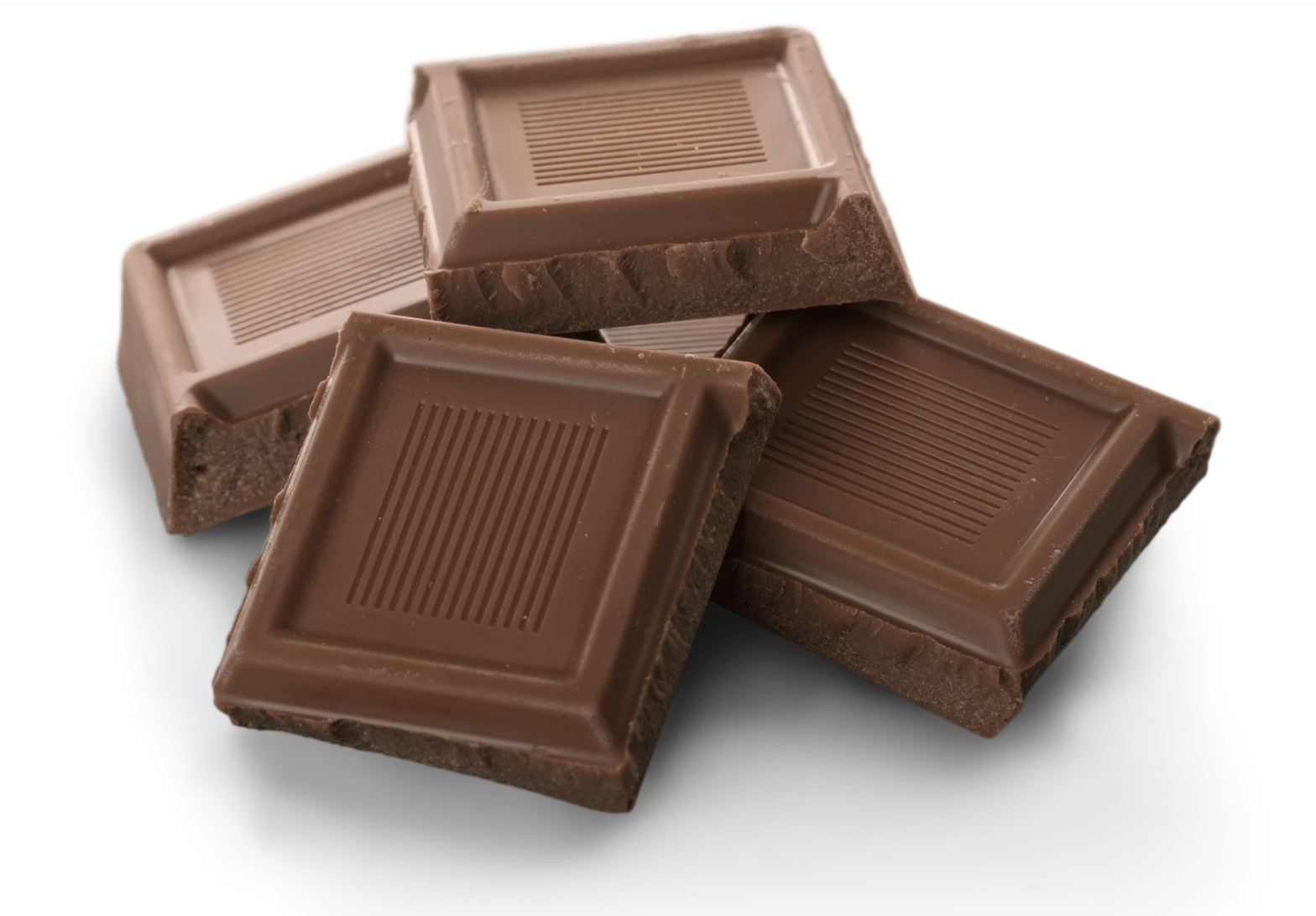
To ask whether chocolate is healthy, we first have to say what we mean. Chocolate is some blend of cocoa solids, cocoa butter, and sugar (plus milk in many products). The cocoa solids carry the compounds everyone gets excited about — flavanols and other polyphenols, plus theobromine and caffeine. Dark chocolate has more solids and less sugar, so more of those compounds, though still 150–170 calories an ounce. White chocolate has essentially no solids, and therefore none of the flavanols driving the health conversation. So when someone says “chocolate is healthy,” the right question is: which chocolate, and which part?
Most of the excitement centers on cocoa flavanols, especially epicatechin, which affects nitric-oxide pathways and blood-vessel function. Plausible biology. But here’s the catch: your wrapper doesn’t tell you the flavanol dose. A bar labeled 70% or 85% cacao isn’t reporting flavanols — those depend on genetics, fermentation, roasting, and processing. “Dutch processing” with alkali makes cocoa darker and smoother while stripping flavanols out. Darker does not reliably mean healthier.
The heart of the matter
Cardiovascular health is where chocolate makes its strongest case. A meta-analysis of cocoa-flavanol trials found improved blood-vessel function — flow-mediated dilation better by about a percentage point — and a much larger analysis of 145 trials and more than 5,000 people found flavanol-rich foods modestly lowered blood pressure, by a few millimeters of mercury, with the biggest effect in people who started out high.
Plausible mechanism, better vessel function, lower blood pressure — you can see how “chocolate is good for your heart” caught on. But those are surrogate outcomes: biomarkers, not the events we actually care about, heart attacks and strokes. That’s why COSMOS, a randomized trial of 21,000 older adults, matters. They took cocoa extract, not candy — flavanols without the sugar, fat, and calories — and after about three and a half years showed no significant reduction in cardiovascular events. Improving a biomarker is not the same as improving health — a lesson that reaches well beyond chocolate.
Brain, mood, and sleep
Could chocolate protect the brain? COSMOS-Mind and a detailed neuropsychological sub-study both found no meaningful benefit of cocoa flavanols on memory, executive function, or global cognition. Chocolate is not a dementia preventive. Darn.
Mood is more interesting. A systematic review found several small studies reporting improved or less-negative mood after chocolate, though the research is thin. My favorite is a study of 258 people split into chocolate-or-crackers, eaten mindfully or normally: only one group’s mood clearly rose — those who ate chocolate mindfully. Maybe chocolate’s mood lift isn’t a mysterious drug effect at all, but what happens when we slow down and savor something we love.
Then there’s sleep — my brownies. An ounce of dark chocolate has 20–25 mg of caffeine, four ounces close to 90 mg — about a small cup of coffee. A sleep experiment found caffeine disrupted sleep even six hours before bed, a far bigger dose than any bar delivers, so it doesn’t prove chocolate ruins sleep. But if you’re caffeine-sensitive, a large evening serving is worth a personal experiment. And despite those stimulating compounds, a trial in trained cyclists found dark chocolate didn’t improve performance.
The real downsides
Chocolate’s clearest cost is simple: calories — 650–700 in four ounces. The Swiss don’t gain ten pounds a year, so they compensate somewhere. But the calories are real, and they count. Saturated fat comes with a nuance: much of cocoa butter’s is stearic acid, and feeding studies comparing cocoa butter, milk chocolate, and dairy butter found cocoa butter didn’t raise LDL cholesterol the way other saturated fats can. Reassuring — though “cocoa butter is health food” still goes too far.
Where I net out
Voltaire wrote that “the best is the enemy of the good.” I think he was talking about chocolate — I keep wanting to file it under superfood or junk, and it refuses to sit in either drawer. It isn’t perfect: the flavanols help vessels and blood pressure but haven’t been shown to prevent heart attacks or dementia, it’s calorie-dense, and a big evening serving can cost me sleep. But it’s also pretty good — its saturated-fat story is milder than feared, reasonable amounts carry little risk for most healthy people, and, most of all, we love it.
Remember that the mindful eaters, not the mere eaters, were the ones whose mood improved. Maybe we don’t need chocolate to be medicine to justify eating it; that may be the mistake we’ve made for centuries. The question needn’t be “will chocolate help me live longer?” It’s enough to ask whether it adds something to my life without doing me meaningful harm.
So if you enjoy chocolate, enjoy it — without much guilt. Watch the quantity. If it disturbs your sleep, eat it earlier. And instead of mindlessly working through a bar, eat a little less and truly savor it. Chocolate may not help me live long. But it certainly helps me live well. And sometimes, good is good enough.
Live long and well.
Scientific research underscores the intricate interplay between lifestyle factors and human health. Exercise, a cornerstone of well-being, enhances cardiovascular health, boosts mood, and promotes cognitive function. Coupled with proper nutrition, it fosters optimal physical performance and supports immune function. Beyond the individual, social ties exert profound effects on health, buffering against stress and enhancing longevity. Meanwhile, exposure to hot and cold environments elicits physiological adaptations, bolstering resilience and metabolic efficiency. Adequate sleep, essential for cognitive consolidation and metabolic regulation, underscores the importance of restorative rest. Moreover, the mind-body harmony underscores the intricate relationship between mental and physical health, highlighting the profound impact of mindfulness and stress management on overall well-being. Integrating these factors into daily life cultivates a holistic approach to health promotion and disease prevention.