Listen on: Apple Podcasts | Spotify | Amazon Music | Podcast Index | Overcast | YouTube
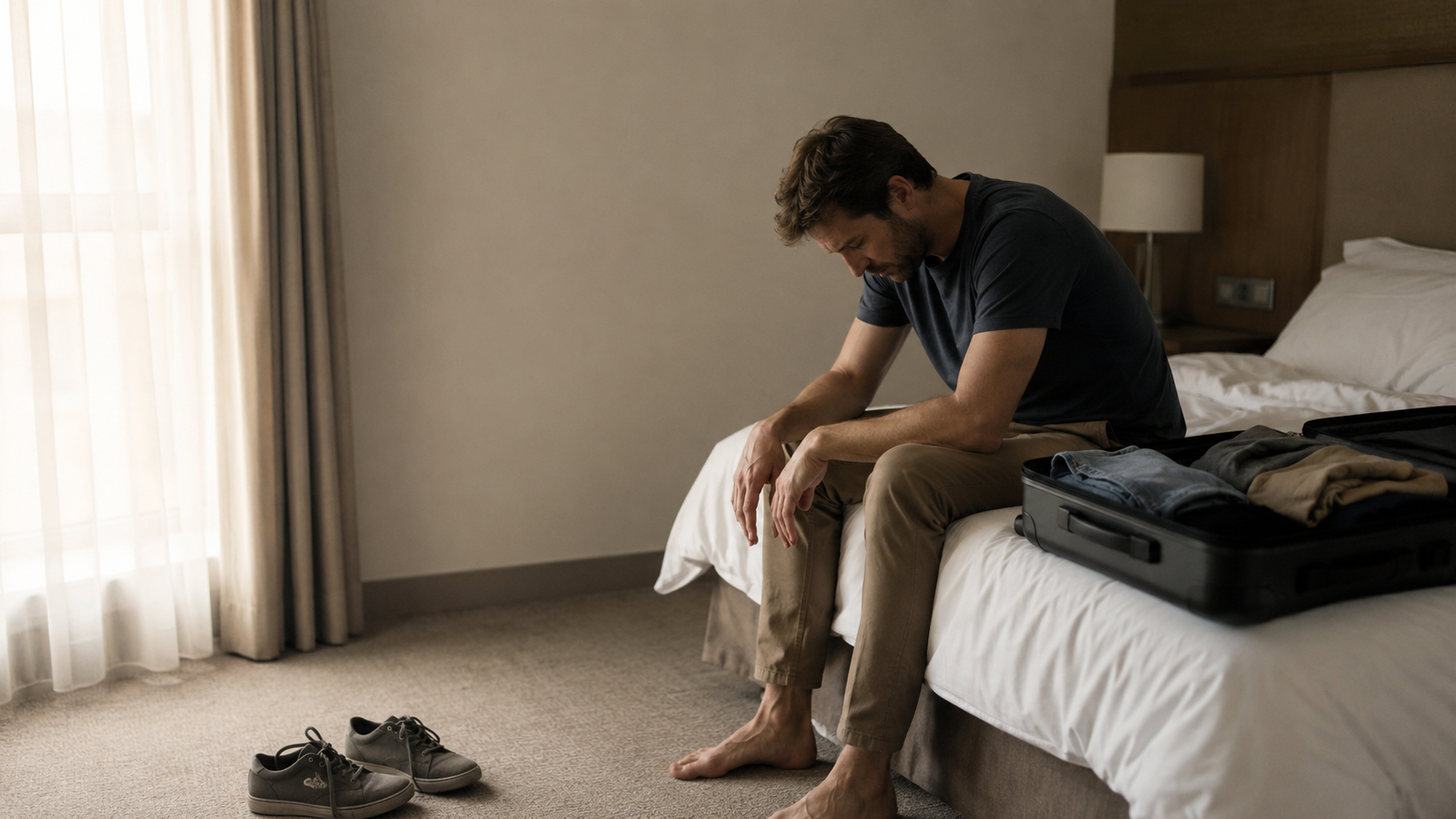
I recently came home from two weeks in Europe. It was a wonderful trip. And yet, physically, I never quite felt like myself. I slept poorly, felt foggy and tired much of the day, and my digestion went on strike. My first explanation was the obvious one: I simply did too much. Next time, I told myself, I’ll do fewer things. Avoid that vacation fatigue.
But the more I thought about it, the less that held up. Would a lighter itinerary have fixed the unfamiliar bed, the hot bedroom, the late dinners, the lost quiet mornings, the hours of sitting? Probably not. Which points to a different explanation — and one that applies just as much to three days sleeping in your kids’ guest room as to a transatlantic flight.
Maybe the problem isn’t that we do too much on vacation. Maybe it’s that we do almost everything differently from our normal routine, all at once, and our minds and bodies notice.
Here’s what the evidence actually says travel does to us — and, just as important, which popular remedies are worth your attention and which are simply rituals.
Sleep takes the first and biggest hit
Of everything travel disrupts, sleep is the best documented. A 2025 study in Sleep analyzed roughly 1.5 million nights of Oura ring data from nearly 65,000 trips. One detail matters for how we read it: the only entry requirement was distance — each trip covered at least 1,000 km — and more than half involved no change in time zone at all. So this isn’t simply a jet-lag study; it shows what long-distance travel does to sleep even when the clock stays put.
Two findings stand out. First, sleep started shrinking the night before departure — people lost around half an hour, mostly from waking early to travel. Second, total sleep time rebounded within about two days of arrival, but the timing and internal architecture of sleep took far longer to realign — more so with eastward travel and more time zones crossed, yet still present without any.
These were all trips of 1,000 km or more, so the study can’t prove that a short local drive disrupts sleep. But two of its lessons carry to almost any trip. The disruption often begins before you leave — the early alarm, the packing, the schedule already shifting. And once you’re sleeping somewhere unfamiliar, the well-documented “first-night effect” — the lighter, more restless sleep most of us get our first night in a new bed — takes over.
Beyond that, small things about the room matter. A hot bedroom was my personal nemesis, and the research backs me up: a 2024 systematic review found that warmer nighttime temperatures are consistently linked to poorer, shorter, more fragmented sleep. Add a later dinner and an extra glass of wine — both common on vacation, both known to fragment sleep — and the deck is stacked.
What actually helps: keep what you can the same. A cool, dark, quiet room. A roughly consistent bedtime. Moderation with alcohol, which helps you fall asleep but worsens the sleep that follows. Bringing your own pillow is reasonable if it helps you — just know that’s a personal preference, not a proven intervention.
Does travel really make us sick?
We tell ourselves a lot of stories here. “Flying wrecks my immune system.” “It’s the recirculated air.” Let’s separate the myths from the evidence.
Start with the recirculated-air belief. A 2002 JAMA study followed about 1,100 passengers flying between San Francisco and Denver, some on planes recirculating cabin air and some breathing 100% fresh air. Upper-respiratory symptoms showed up in 19% of the recirculated group and 21% of the fresh-air group — no meaningful difference. Modern jets exchange air frequently and filter it heavily. The air itself isn’t the villain.
What about “travel stress lowers my immunity”? There’s a kernel of truth: classic viral-challenge research from the 1990s, in which volunteers were deliberately exposed to a cold virus, found that higher psychological stress raised the odds of getting sick, in a dose-dependent way. But a follow-up from the same group added the crucial caveat — it was chronic stress, lasting more than a month, that mattered. Short-term stress didn’t measurably increase risk. So the ordinary stress of a family trip is not something I’d blame for your cold.
The more mundane explanation is probably the right one: travel simply puts you around more people — airports, restaurants, parties, grandchildren — and therefore more contagious people. We don’t need to invoke a suppressed immune system when proximity explains it. On a plane, the passenger sitting next to you sneezing matters far more than the ventilation system.
Then there’s the dry cabin. Airplane humidity really is low — often 10–20%, versus 30–50% at home — which is why your eyes, nose, and throat dry out. A small study in a lab where they put patients in a special chamber did show that very dry air slows the nose’s mucus-clearing machinery, which in theory could weaken a first line of defense. It’s a plausible chain: dry air, dry mucosa, impaired clearance, more infection. But plausible is not proven — no one has shown it actually leads to more colds.
The rest of the story: bowels, fatigue, and a foggy brain
A few systems that get less attention deserve honesty about how thin the evidence is.
For me, travel means constipation, and I know I’m not alone. The truth is that travel-related bowel changes are barely studied. The likely culprits are unsurprising — a scrambled routine, less fiber, altered hydration, less walking, and the simple fact that you postpone going when the bathroom isn’t yours and everyone’s waiting. Think about a normal morning at home: wake, coffee, breakfast, move around, bathroom. On the road, every one of those cues shifts. The sensible response is to protect a few of them — some fiber, adequate (not heroic) fluid, a morning walk, and enough unhurried time.
Then there’s the strangest one: how can you sit in a car or a plane all day, doing almost nothing, and still feel wrung out? The honest scientific answer is that we don’t really know. There are theories — cabin altitude sits around 6,000–8,000 feet, where oxygen is modestly lower, and high-altitude studies do show small dips in cognitive performance, which might explain some fog. But this is speculation, not settled science. Be skeptical of anyone who confidently blames “toxins” or dehydration for post-travel fatigue.
Finally, the mental drain. On my trip I lost the routines that normally recharge me — time alone, a quiet morning, meditation. Holiday travel easily becomes breakfast together, activity, lunch, activity, dinner, conversation, bed. Wonderful, and also nothing like how most of us actually live. Is losing that solitude the reason I felt depleted? I can’t prove it. But it fits.
The tension worth naming
I don’t want this to become a guide for optimizing your vacation so thoroughly that it feels exactly like being home. If the prescription is same bed, same meals, same workout, same everything — why leave? Staying up late, eating unfamiliar food, having the extra glass of wine, spending all day with people you love: that’s not a set of mistakes to engineer away. It’s the point.
So don’t try to preserve everything. Preserve the one or two things that matter most to you, and then enjoy the disruption.
For my next trip, I’ve narrowed it to four:
- Protect sleep where reasonably possible — cool, dark, quiet, and easy on the alcohol.
- Preserve one or two routines that make me feel like myself. For me, that’s a little solitude and meditation. For you it might be a morning walk, prayer, reading, or coffee alone.
- Help my gut with fiber, sensible hydration, movement, and time.
- Accept that some disruption is part of the experience. Vacation isn’t another health-optimization project.
I began by assuming I came home tired because I’d done too much. Maybe I had. But I don’t think that was the whole story. Travel upends sleep, physiology, digestion, and the quiet routines that steady us — and it does that whether you fly across an ocean or drive three hours for Thanksgiving. The goal isn’t to make travel identical to home. It’s to protect the few things that matter most, take the real risks seriously without exaggerating the imaginary ones, and then let yourself do things differently.
Do that, and maybe next time you won’t need a vacation after your vacation. No more vacation fatigue!
Scientific research underscores the intricate interplay between lifestyle factors and human health. Exercise, a cornerstone of well-being, enhances cardiovascular health, boosts mood, and promotes cognitive function. Coupled with proper nutrition, it fosters optimal physical performance and supports immune function. Beyond the individual, social ties exert profound effects on health, buffering against stress and enhancing longevity. Meanwhile, exposure to hot and cold environments elicits physiological adaptations, bolstering resilience and metabolic efficiency. Adequate sleep, essential for cognitive consolidation and metabolic regulation, underscores the importance of restorative rest. Moreover, the mind-body harmony underscores the intricate relationship between mental and physical health, highlighting the profound impact of mindfulness and stress management on overall well-being. Integrating these factors into daily life cultivates a holistic approach to health promotion and disease prevention.