Listen on: Apple Podcasts | Spotify | Amazon Music | Podcast Index | Overcast | YouTube
A few months ago, I shared that my dear wife Gail — the love of my life, my best friend and soul mate — had advanced uterine cancer. By all current testing, she now appears to be cancer free, and I am profoundly grateful. But in those early days, before we knew whether surgery would work, before we knew whether the chemo and radiation would take hold, I was in a state of genuine panic. And I remember thinking: if Gail dies, I might truly die of a broken heart.
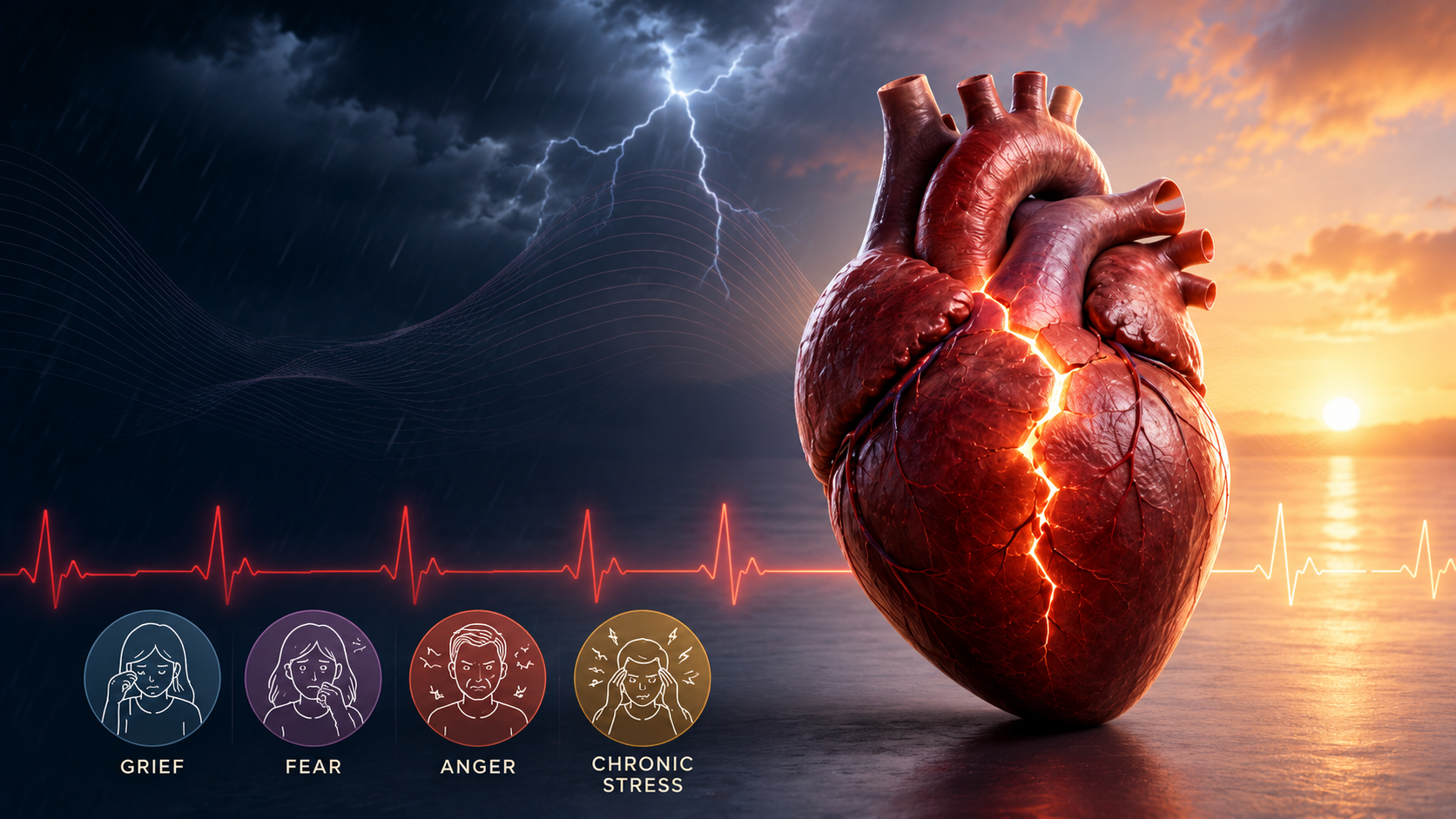
That sounds melodramatic. But is it? I want to examine four ways emotions can touch the heart, and the last one affects nearly all of us. Can grief actually kill you? Can fear? Can a burst of rage trigger a heart attack in an otherwise healthy person? Those are the dramatic cases. But the more relevant question and the one with the most evidence behind it — is less overt: what does chronic, everyday stress do to our hearts over months and years?
The Medical Reality of Broken Heart Syndrome
Let’s start with the clearest medical example: Takotsubo syndrome, stress cardiomyopathy or broken heart syndrome. Here’s what happens. A person suffers a horrendous loss, shock, or intense acute stress. Shortly after, they develop chest pain and shortness of breath. Physicians may suspect a heart attack. But when they look for a blocked artery, they often don’t find one.
Instead, the heart’s main pumping chamber stops working correctly, ballooning into a distinctive shape — the shape of a Japanese octopus vessel called a takotsubo, which is how the condition got its name. A landmark New England Journal of Medicine study of 1,750 patients with Takotsubo found that mortality in these patients was comparable to those hospitalized with a conventional heart attack. Dying of a broken heart isn’t just a metaphor. It is a rare but real biological event.
There’s also striking data on bereavement itself. A large study by Elwert and Christakis followed 373,000 elderly married couples and found that the death of a spouse raised the survivor’s mortality risk across nearly all causes of death. A meta-analysis of 15 prospective cohort studies covering over 2.2 million people found a 41% increased risk of death in the first six months of widowhood, tapering to 14% thereafter — and the effect was significantly stronger for men than women. My worry about my own health, had Gail not survived, was not irrational.
Fear, Anger, and the Vulnerable Heart
Can you be frightened to death? Rarely, and most likely in someone with an already vulnerable heart — but yes. Fear activates the sympathetic nervous system. Adrenaline and stress hormones raise heart rate, blood pressure, vascular tone, and electrical excitability. In a vulnerable person, that surge can initiate a dangerous arrhythmia or coronary spasm.
A classic New England Journal study of the 1994 Northridge earthquake — an event I witnessed firsthand — illustrated this vividly. On a typical day in Los Angeles, about four people die suddenly of cardiac causes. On the day of the earthquake, 24 people died. Fear as a trigger for cardiac death: likely.
Anger tells a similar story. A systematic review by Mostofsky and colleagues found that outbursts of anger were associated with a measurably higher risk of cardiovascular events shortly afterward. For a healthy person, the absolute risk from one angry episode is low. For someone with known heart disease and a vulnerable plaque or rhythm instability, anger may initiate an event.
The Bigger Question: Chronic Stress
Here’s the truth: most grief does not cause Takotsubo syndrome. Most fear or anger does not cause a heart attack. But these extreme cases illuminate something important. The same biological pathways of adrenaline surges, cortisol spikes, elevated blood pressure, sympathetic nervous system activation — don’t only fire on your worst day. They fire repeatedly, over years, for many of us.
An important Lancet study compared people who had a first heart attack against those who had not, and found that work stress, home stress, financial strain, stressful life events, and a low sense of personal control were all significantly associated with increased heart attack risk. A meta-analysis of over 600,000 people found that psychological distress was associated with a 28% increased risk of a cardiovascular event.
Stress is not as powerful a cardiac risk factor as smoking, hypertension, diabetes, or elevated LDL cholesterol. But stress is common — and because it’s common, it matters for many of us. Chronic stress directly elevates heart rate, blood pressure, cortisol levels, and sympathetic nervous system tone. It also nudges us toward behaviors that compound the damage: less exercise, worse sleep, more alcohol, social withdrawal.
The Protective Power of Connection
Earlier I noted that losing a spouse raises the risk of death. The flip side is equally striking: having strong social relationships appears to protect us. A meta-analysis of 148 studies by Holt-Lunstad and colleagues found that people with stronger social relationships had a 50% better chance of survival compared with those with weaker ones. Loneliness, conversely, was associated with increased risk of coronary heart disease and stroke.
We don’t fully understand the mechanism. It may involve better self-care, medication adherence, earlier medical attention, a buffering effect of feeling known and loved, or residual confounding. But the signal is consistent and significant.
What the Evidence Suggests We Do
In a prior article on stress, I reviewed what the evidence actually supports for managing chronic stress. The interventions with the strongest backing: better sleep, regular exercise, breathwork, and meditation. There is also surprising evidence for music therapy and aromatherapy with lavender. What does not have strong evidence? Many of the supplements and apps aggressively marketed to calm you.
And of course, invest in your relationships. The data is clear. Social connection is not just good for the soul. It appears to be good for the heart.
The Bottom Line
Can you die of a broken heart? Rarely, yes. Can you be frightened to death? Rarely, yes. Can anger trigger a cardiac event? Sometimes, especially in someone already vulnerable.
But for most of us, the bigger question is not whether one terrible moment will kill us. It is whether our everyday lives are placing our heart under sustained, cumulative stress. The heart is a pump, yes. But it is a pump that operates inside a life — inside relationships, fears, grief, joy, and chronic low-grade pressure.
The extreme cases earn the headlines. But the slow, quiet weight of chronic stress, loneliness, and unmanaged anxiety is likely what will matter most for most of us.
Take care of your heart. Take care of yourself. And take care of those you love.
Dr. Bobby Dubois is a physician and scientist with publications on evidence-based medicine, appropriateness of care, and the value of health care interventions. He writes a Substack and podcasts at Live Long and Well With Dr. Bobby.
Scientific research underscores the intricate interplay between lifestyle factors and human health. Exercise, a cornerstone of well-being, enhances cardiovascular health, boosts mood, and promotes cognitive function. Coupled with proper nutrition, it fosters optimal physical performance and supports immune function. Beyond the individual, social ties exert profound effects on health, buffering against stress and enhancing longevity. Meanwhile, exposure to hot and cold environments elicits physiological adaptations, bolstering resilience and metabolic efficiency. Adequate sleep, essential for cognitive consolidation and metabolic regulation, underscores the importance of restorative rest. Moreover, the mind-body harmony underscores the intricate relationship between mental and physical health, highlighting the profound impact of mindfulness and stress management on overall well-being. Integrating these factors into daily life cultivates a holistic approach to health promotion and disease prevention.